2025 had been the year of AI agents, and it contunues in 2026. The Future is Agentic. We engineer systems that think, plan, reason and act. Move beyond experimentation — deploy Agentic AI that drives speed, automation, and outcomes.
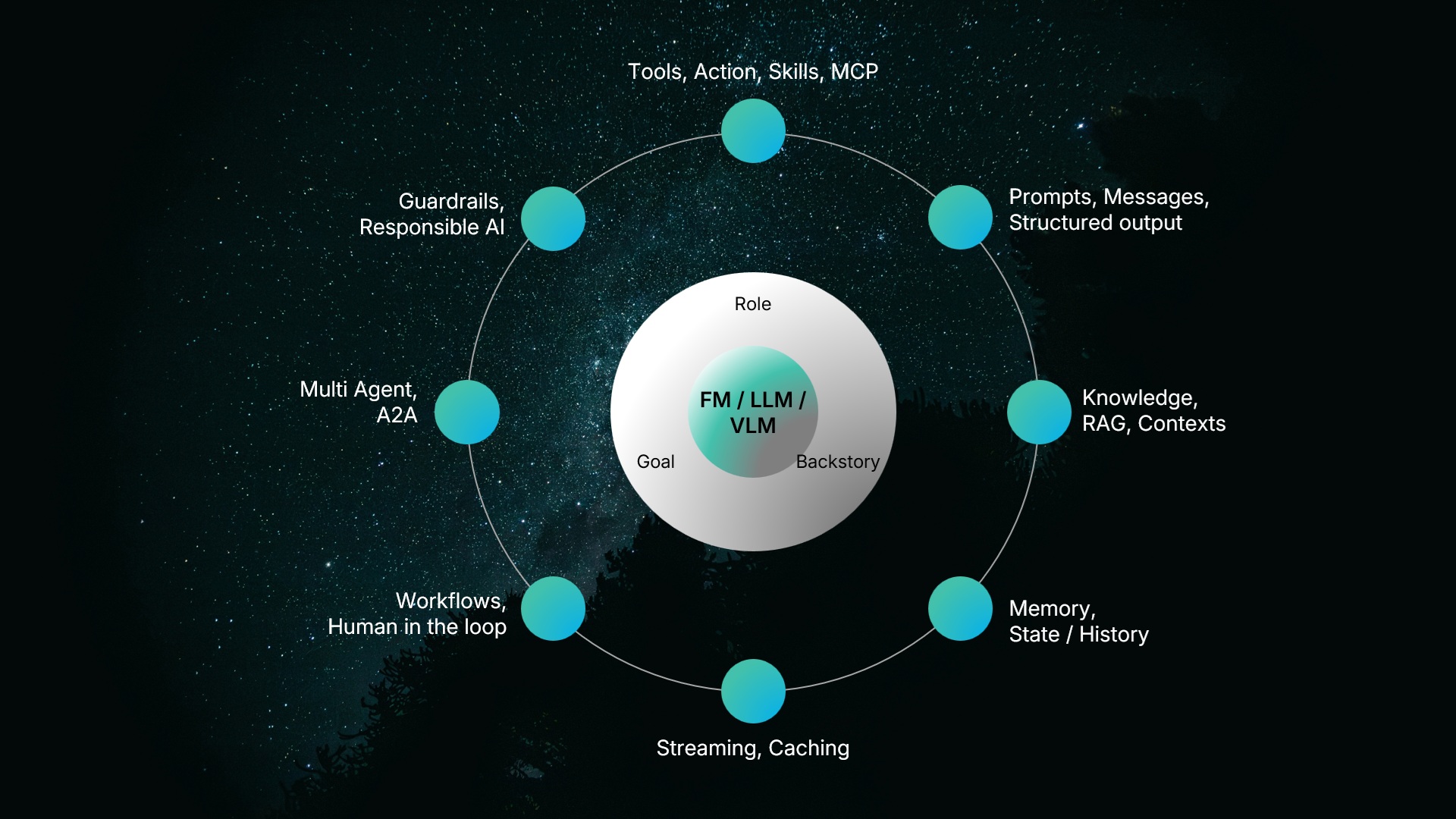
Start a strategy discussionAgentic AI uses autonomous AI agents (that can Think, Plan, Reason and Act) to redefine how to interact with systems and apps. These agents can perform complex tasks, make decisions, and adapt to changing environments, enabling businesses to automate workflows, enhance customer experiences, and drive innovation at scale. They are different from previous generation Chatbots and generative AI assistant that primarily focus on text generation and conversation. Below are key characteristics of Agentic AI systems:
State: The enterprise uses generic LLMs (ChatGPT/Claude) for basic summarization and drafting.
Limitation: "The Island of Knowledge." It knows things but can't do anything. Data is siloed and requires manual copying/pasting.
VisionTomoro Focus: Context Ingestion & Security Guardrails.
State: AI is connected to internal company documents (Retrieval-Augmented Generation). It answers questions based on your data.
Limitation: It is still reactive. A human must ask a question to get a result. It cannot execute transactions.
VisionTomoro Focus: Data Fabric Engineering & Vector Database Optimization.
State: The AI is given "Tools" (APIs, SQL access). It can perform specific tasks, like "Update a CRM record" or "Generate a Jira ticket."
Limitation: Restricted to single-turn tasks. It lacks the "Reasoning" to handle complex, multi-step projects.
VisionTomoro Focus: Tool-Use Architecture & Intent Engineering.
State: Multiple specialized agents (e.g., a "Researcher Agent," a "Coder Agent," and a "QA Agent") work together to solve a high-level goal.
Limitation: Requires heavy human supervision and "AgentOps" to prevent loops or errors.
VisionTomoro Focus: Multi-Agent Orchestration (LangGraph/CrewAI) & Agentic DevOps.
State: Self-learning agents manage end-to-end business processes (e.g., autonomous claims processing or self-healing cloud infra). Humans move to a "Governor" role.
Advantage: Zero-latency execution. The enterprise operates at the speed of light, not the speed of meetings.
VisionTomoro Focus: AgentOps Lifecycle Management & Neo-Operating Model Design.
Develop comprehensive AI Agency and Agentic AI strategies aligned with your business objectives, including prioratized use cases, technology stack selection, blueprints and implementation roadmaps.
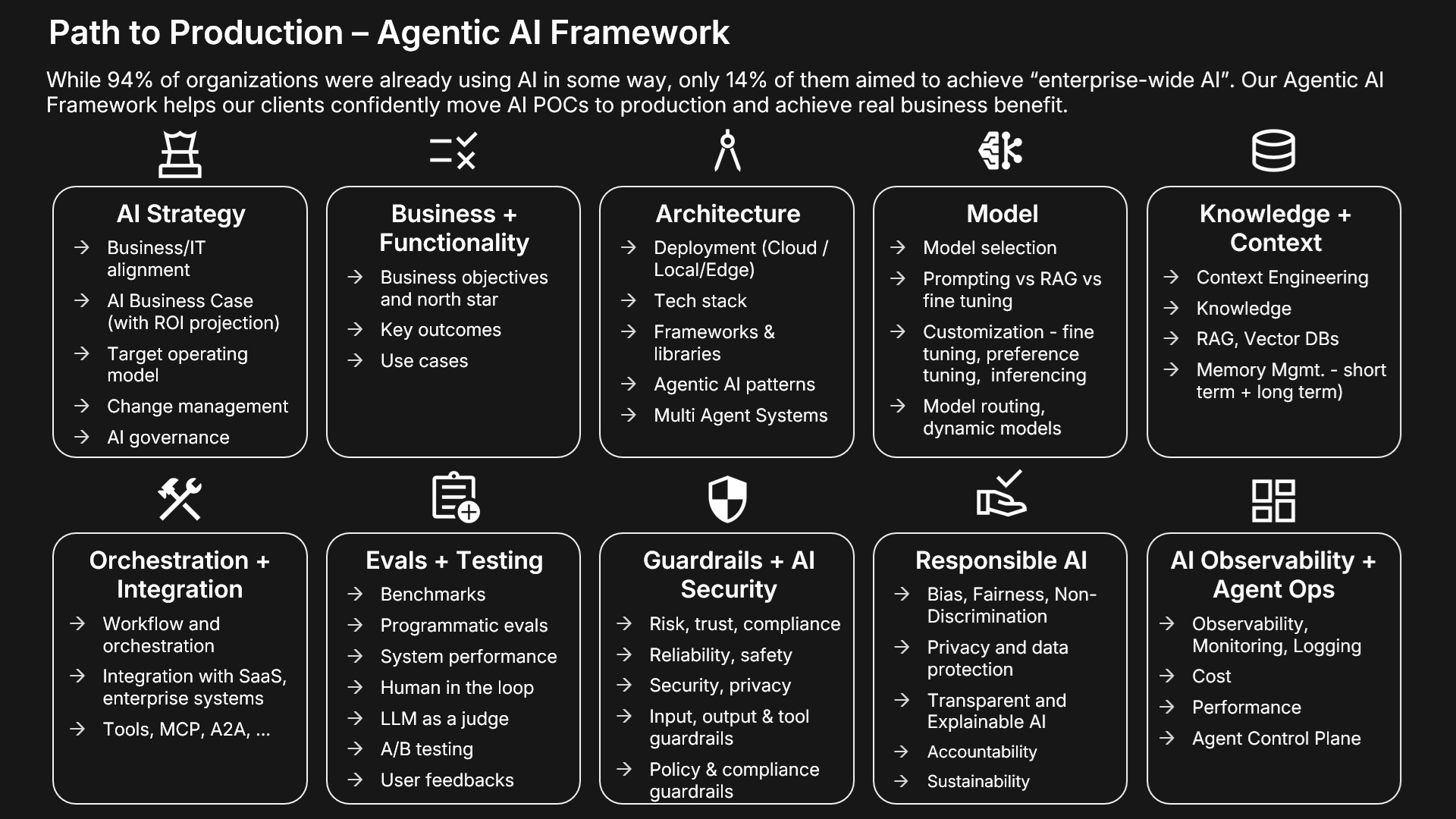
We rapidly assess your organization's readiness for Agentic AI adoption using VisionTomoro 'AI adoption framework' and it's seven pillars.
Think about AI agency, build multi agent architecture using open source protocols and tools. Secure and scale your AI agents.
Architect and orchestrate multi-agent systems for complex AI workflows using frameworks like Crew.AI, Google ADK or LangChain/LangGraph
Develop and deploy Agentic AI applications, from large language models to custom AI solutions for your specific use cases.
Use Vibe Coding and AI assisted software engineering across all the phases of software development lifecycle - generate specs, generate / debug code, create unit tests, understand large code bases. Do much more
Bespoke intelligence for your unique context. We build domain-specific Copilots and private GPTs that are grounded in your proprietary data, ensuring your team has an AI partner that actually understands your business nuances.
Implement ethical AI practices, bias detection, fairness frameworks, and governance structures to ensure responsible AI deployment.
Manage, monitor, and optimize large language models and AI agents in production, ensuring performance, reliability, and cost efficiency.
Placeholder content for tab 1.
Placeholder content for tab 2.
Placeholder content for tab 3.
Placeholder content for tab 4.
Placeholder content for tab 5.
Placeholder content for tab 6.
Placeholder content for tab 7.
Leverage Amazon Bedrock to build and scale Agentic AI applications with access to leading foundation models. Our expertise includes model selection, RAG implementation, and deployment of production-ready Gen AI solutions on AWS.
Implement comprehensive Gen AI solutions using Azure OpenAI Service and AI Foundry. Build enterprise-grade AI applications, custom copilots, and integrated AI experiences within the Microsoft ecosystem.
Build and deploy machine learning models on Google Cloud Platform. Our experience spans Vertex AI Model Garden, custom model training, and integration with Gemini models for enterprise AI solutions with advanced MLOps.
Develop sophisticated agentic AI applications using LangChain and LangGraph frameworks. We create intelligent workflows, RAG pipelines, and autonomous agents that can reason, plan, and execute complex business processes.
Integrate OpenAI's GPT models, embeddings, and fine-tuning APIs. Our expertise includes prompt engineering, assistant APIs, and building custom solutions using advanced language models for content generation and automation.
Utilize Hugging Face's model hub and transformers library to access thousands of pre-trained models. We handle model selection, fine-tuning, and deployment of open-source models across cloud and on-premises environments.
Client: Indian health and wellness major
Challenge: Reinventing end-to-end patient-doctor interaction process across background capture, diagnosis, medications, EMR update, and prescription generation using gen AI & AI/ML.
Outcome: This resulted in 75% more hands-free time for doctors, 20% increase in C-SAT score, and improved patient experience (NPS).
Tech stack: LangChain, LangGraph, AWS BedRock
Client: Indian multinational manufacturing conglomerate
Challenge: AI strategy and assessment project to help client with enterprise-wide AI assessment (AI business case, identify & prioritize use cases, goals & priorities, 3-year roadmap, responsible AI strategy).
Outcome: AI business case, identify & prioritize use cases, goals & priorities, 3-year roadmap, responsible AI strategy
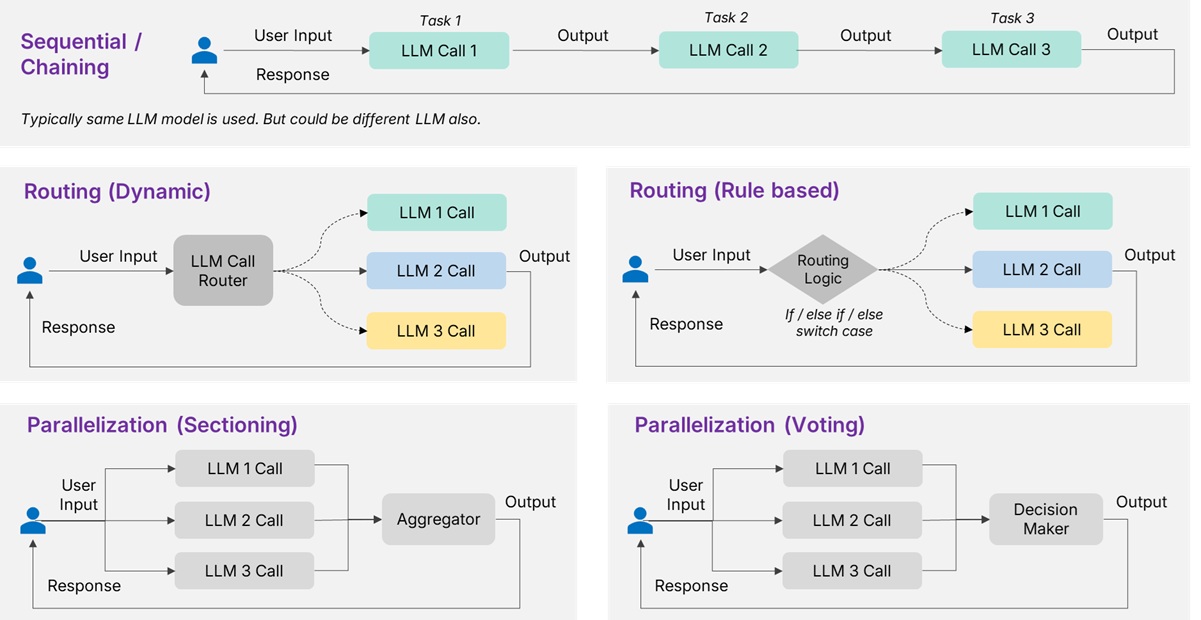
Multi-agent orchestration patterns define the architecture and communication strategies for coordinating multiple AI agents working together to solve complex problems. These patterns enable enterprises to design scalable, maintainable, and efficient agentic systems.
Key orchestration patterns include sequential task execution, parallel processing, hierarchical control structures, and peer-to-peer collaboration. Each pattern is optimized for different use cases and complexity levels.
VisionTomoro specializes in implementing these patterns using industry-leading frameworks and best practices, ensuring your multi-agent systems operate with maximum efficiency and reliability.